Sustainability with vision



Efficient ESG reporting through automation and AI
With automation, AI and intelligent dashboards, ESG reporting is becoming a mandatory task to an opportunity for sustainable growth.
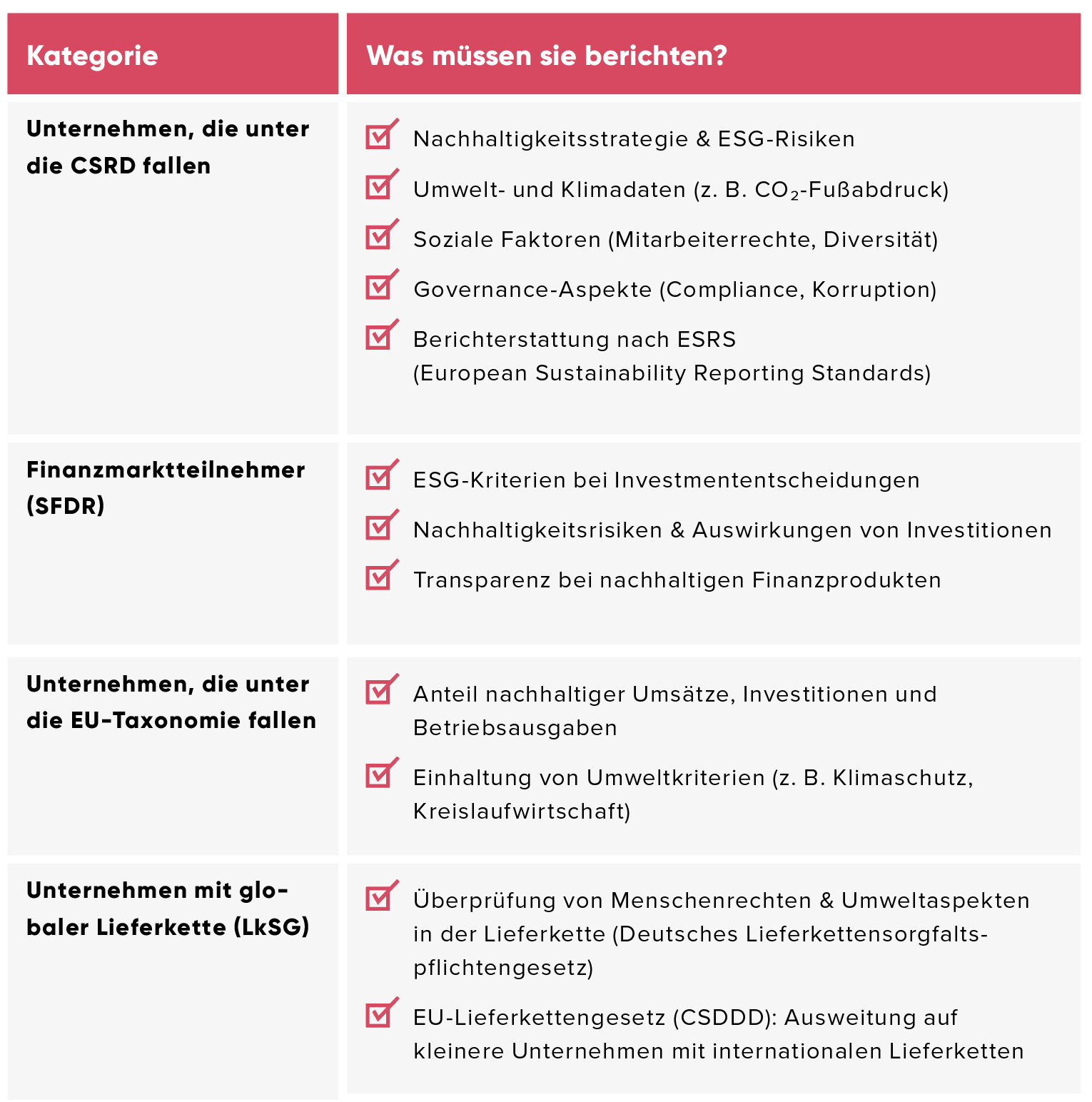
Since 2024, many companies have been required to implement ESG reporting (Environmental, Social, Governance) through CSRD (Corporate Sustainability Reporting Directive), SFDR (Sustainable Finance Disclosure Regulation) and supply chain laws — SMEs are also increasingly required to report.
The SFDR primarily affects banks, insurance companies, fund providers and other financial market participants. They must disclose how sustainability risks are incorporated into their investment decisions and which ESG criteria they apply.
Companies with global supply chains are already subject to the German Supply Chain Due Diligence Act (LkSG) and, since July 2024, i.e. the EU Supply Chain Directive (CSDDD), which extends the scope to smaller companies. They are required to analyse and disclose human rights and environmental risks along their supply chains.
More and more companies recognize their responsibility to integrate ESG criteria into their corporate strategy. A structured reporting Helps to create transparency for investors and customers, to secure competitive advantages and to reduce your own CO2 footprint in a targeted manner.
Obstacles to getting started with sustainable data management
The initial effort involved is often enormous: In addition to topics such as data management and quality, regulatory requirements must also be met, which can be difficult with frequently changing regulations. In addition, companies face technological challenges, such as choosing a suitable platform, integration into existing IT systems and compliance with data protection requirements. Strategic implementation also plays a decisive role — ESG must be sustainably integrated into corporate culture.
To ensure their credibility, companies must ensure that ESG measures are not only established in the short term to avoid greenwashing. This is not always easy, as the benefits of ESG measures, which are reflected in financial and ESG indicators, are not immediately visible. At the same time, however, there is growing pressure from investors, customers and regulators to make ESG performance transparent and measurable. In the long term, a sustainable ESG strategy pays off, as it not only strengthens the trust of investors and stakeholders, but also leads to improved financial performance, a stronger brand reputation and a more resilient business model. Companies that implement ESG measures consistently and authentically, i.e. benefit from regulatory advantages, innovative business opportunities and stronger employee loyalty.
Automated ESG Reporting: From Manual Effort to Digital Efficiency
Although the effort is high at first, once you have set up an initial ESG report, the further path becomes much easier. Automation and AI-based analysis tools offer ESG reporting companies a real opportunity to significantly simplify the process while improving the quality of their reporting. When companies rely on structured, data-based reporting right from the start and the right technologies , the effort is not only reduced over time, but the process is also significantly more efficient.
With the right data infrastructure Data can be automatically extracted from various source systems and converted into a uniform format. This reduces the risk of errors and at the same time reduces the time required to collect data. There is no need for manual work.
AI-based analyses for proactive sustainability strategies
The use of AI-based analysis tools makes ESG reporting not only a compulsory exercise, but a valuable source of strategic insights. AI can not only evaluate basic data, but also identify profound patterns and trends that are of great importance for sustainable corporate management. This allows companies to react to changes at an early stage, for example when developing new ESG requirements or when environmental and social risks become apparent. AI helps predict this data And predict potential developments so that companies can act proactively instead of reactively.
Real-time transparency through intelligent ESG dashboards
ESG dashboards provide a transparent overview in real time. They make it possible to monitor all relevant ESG data at a glance and immediately see whether corporate strategies are developing as desired or whether adjustments are necessary. Dashboards make it easy to communicate progress to stakeholders such as investors, customers, and regulators by providing clear and understandable visualizations of ESG data. This transparency not only increases trust in reporting, but also helps create a positive corporate culture that promotes sustainable practices.
Conclusion: Why investing in a modern data infrastructure pays off
By using these technologies, companies can significantly reduce the recurring costs associated with ESG reporting. automation And artificial intelligence not only save huge amounts of time, but also improve the quality and accuracy of reports. The one-time effort to invest in an effective system pays off in the long term, as ongoing costs are reduced, while compliance with regulations, communication with stakeholders, and the strategic use of ESG data are significantly improved. <
This article was first published in our magazine data! Issue 5. Read now for free.
.webp)